
Disc, Pin, and Post Type Insulators in India: Complete Guide & Technical Specs
In the Indian Power Transmission and Distribution (T&D) ecosystem, Electrical Insulators are essential components that ensure operational safety, mechanical support, and uninterrupted power flow. From Power Grid Corporation of India Limited (PGCIL) to state DISCOMs and private EPC contractors, insulator selection depends strictly on system voltage levels, mechanical loads, and environmental conditions.
This comprehensive guide explores the three primary insulator types widely deployed across India — Pin Type, Disc (Suspension) Type, and Post Type Insulators — detailing their operational mechanics, voltage capacities, Indian Standards (IS), and comparative applications.
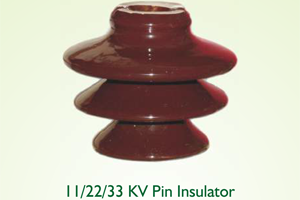
1. Pin Type Insulator (Up to 33 kV Distribution Systems)
Pin Type Insulators are among the most traditional and cost-effective solutions for electrical power distribution. The design features a solid ceramic, glass, or composite body mounted onto a threaded forged-steel pin, which is rigidly bolted to the cross-arm of a utility pole.
- Operating Voltage Range: Ideal for 11 kV, 22 kV, and 33 kV distribution lines.
- Core Materials: Wet-process Porcelain, Toughened Glass, and Silicon Rubber Polymer Composites.
- Governing Indian Standards: IS 731 (for voltages >1000V) and IS 1445.
Key Technical Features:
- Conductor Attachment: The primary line conductor rests in the top groove and is securely bound using an aluminum tie wire.
- Engineering Boundary: Beyond 33 kV, Pin Insulators become disproportionately heavy, bulky, and expensive, making them structurally and economically impractical.
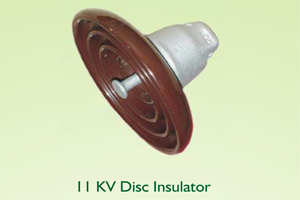
2. Disc Type / Suspension Insulator (For High & Extra-High Voltages)
Disc Type Insulators (commonly called Suspension Insulators) operate on a modular configuration. Individual ceramic or toughened glass discs are linked in series using metal fittings (ball-and-socket or clevis-tongue arrangements) to form a flexible "insulator string."
- Operating Voltage Range: 33 kV, 66 kV, 132 kV, 220 kV, 400 kV, up to 765 kV EHV/UHV transmission networks.
- Configuration Logic: A standard single disc is rated for approximately 11 kV line-to-ground capacity. As system voltage increases, additional discs are added to the string (e.g., ~9–10 discs for 132 kV, ~23–25 discs for 400 kV).
- Governing Indian Standards: IS 731 / IEC 60383.
Key Technical Features:
- High Serviceability: If a single disc in a string fails or suffers a puncture, only that specific unit needs replacement rather than the entire assembly.
- Strain Applications: At dead-end towers, sharp turns, and river crossings, these discs are installed horizontally as Strain / Tension Insulators to withstand strong pulling forces.
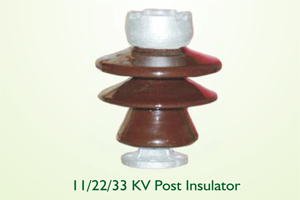
3. Post Type Insulator (For Substations & Switchyard Equipment)
Post Type Insulators are high-rigidity, heavy-duty structures engineered to withstand massive bending forces, cantilever loads, and electrodynamic stresses generated during short-circuit faults. They serve as primary rigid supports in electrical substations.
- Operating Voltage Range: 11 kV to 400 kV+ in high-voltage substations.
- Key Configurations: Station Post Insulators and Line Post Insulators.
- Governing Indian Standards: IS 2544 (Station Post) and IS 2099 (Bushing Insulators).
Key Technical Features:
- Superior Mechanical Rigidity: Engineered with a solid-core structure to prevent structural failure under severe bending stress caused by heavy busbars and fault currents.
- Substation Applications: Widely deployed to support isolators (disconnect switches), circuit breaker assemblies, transformer terminals, and switchyard busbars.

Technical Comparison Matrix
| Parameter | Pin Type Insulator | Disc Type Insulator | Post Type Insulator |
|---|---|---|---|
| Primary Voltage Range | Up to 33 kV | 33 kV to 765 kV+ | 11 kV to 400 kV+ |
| Main Application Area | Overhead Distribution Lines | High-Voltage Transmission Lines | Substations, Switchyards & Busbars |
| Mounting Configuration | Rigidly mounted on pole cross-arm | Suspended flexibly in a modular string | Directly bolted to steel base structures |
| Dominant Mechanical Load | Compression & Torsion | High Tensile (Pulling) Load | Bending & Cantilever Strength |
| Modularity & Flexibility | Non-modular (Single Piece) | Highly Modular (Adjustable disc count) | Rigid Solid Core / Stackable Posts |
| Relative Cost | Low & Budget-friendly | Moderate to High (Scalable) | High (Due to heavy solid construction) |
Material Evolution in India: Porcelain vs Polymer Insulators
Due to varying climatic conditions across India — ranging from coastal salt belts to heavy industrial zones — power utilities are rapidly transitioning toward advanced materials:
- Porcelain (Ceramic): Offers high thermal stability and long service life. However, porcelain insulators are heavy, prone to transport damage, and susceptible to flashovers in polluted environments due to lower surface creepage efficiency.
- Polymer (Silicone Rubber Composite): Lightweight, shatterproof, and easy to transport. Polymer insulators possess excellent hydrophobicity (water and dirt repellent qualities), making them the preferred choice for polluted and coastal corridors in states like Gujarat, Maharashtra, and Tamil Nadu.
Key Bureau of Indian Standards (BIS / IS Standards)
Compliance with Indian Standards is mandatory for DISCOM, CPWD, and PGCIL procurement tenders:
- IS 731: Porcelain Insulators for Overhead Power Lines with Nominal Voltages Greater Than 1000 V.
- IS 1445: Porcelain Insulators for Overhead Power Lines with Nominal Voltages Up to 1000 V.
- IS 2544: Specification for Porcelain Post Insulators for Systems Greater Than 1000 V.
- IS 9921: Alternating Current Disconnectors (Isolators) and Earthing Switches.
Frequently Asked Questions (FAQs)
Q1. Why is a Pin Insulator not used above 33 kV?
Above 33 kV, the required size, weight, and wall thickness of a Pin Insulator increase exponentially. This makes it highly uneconomical, and the heavy weight imposes excessive mechanical stress on the cross-arm. Therefore, Disc/Suspension insulators are preferred for higher voltages.
Q2. What is Creepage Distance in electrical insulators?
Creepage distance is the shortest path along the outer surface of an insulator between the energized conductor terminal and the grounded metal base. Higher creepage distance (e.g., 31 mm/kV) is required in heavily polluted or coastal areas to prevent electrical flashover during moist conditions.
Q3. What is the difference between Suspension and Strain Disc Insulators?
Both use the same modular Disc Insulators. When the disc string hangs vertically to support the downward weight of the conductor, it is called a Suspension Insulator. When the string is placed horizontally to withstand heavy mechanical tension at line ends, curves, or river crossings, it is called a Strain Insulator.